
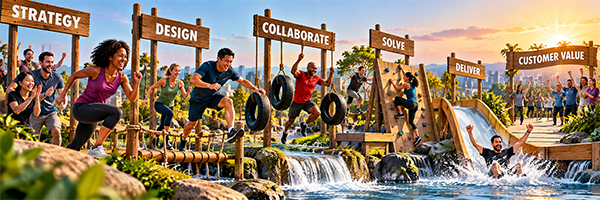
People are among the largest expenses most organizations carry. Executives understand this, and they’re constantly balancing the need to manage labor costs against the need to attract, develop, and retain people capable of delivering exceptional performance. It’s a familiar tension, one that positions investments in people as ostensibly competing with financial performance. But what if that tension isn’t inevitable? What if it’s partly a consequence of how we’ve designed our organizations?
The relationship between people and organizational performance isn’t a new concern. In the 1950s, Eric Trist and his colleagues at London’s Tavistock Institute helped establish Sociotechnical Systems Theory, which recognizes that organizations comprise interdependent social and technical systems. Their central proposition was that these systems should be jointly optimized rather than designed independently. In other words, how people work together matters just as much as the processes and technologies they use.
I think there’s an important opportunity to extend that thinking. In what I call Culture-led Organizational Design, Culture becomes the anchor around which the other elements of an organization are designed. Strategy still provides direction, establishing what the organization must accomplish and how it intends to compete. But Culture provides a reference point for designing the workflows and processes through which the organization creates value.
The distinction is subtle but consequential. It’s one thing to design workflows that accommodate an organization’s Culture. It’s another to design workflows that actively reinforce it. I recently worked with a multinational oil and gas company undergoing a major restructuring. As critical workflows were designed, opportunities for collaboration at consequential decision points were deliberately introduced. These weren’t arbitrary meetings or additional layers of bureaucracy. They were carefully selected opportunities to bring relevant stakeholders into decisions where their perspectives could improve the outcome. The design accomplished two objectives simultaneously. It supported more informed operational decisions while reinforcing the organization’s desired culture of diversity, inclusion, and teaming. Rather than treating cultural development as a separate initiative, opportunities for cultural reinforcement were embedded directly into the work.
This illustrates a progression central to my DHARMA approach to Organizational Design: Alignment, Reinforcement, and Harmonization. Alignment ensures that organizational elements are compatible. Reinforcement deliberately strengthens their relationships. Harmonization seeks synergies that create more value together than the elements could produce independently.
And that’s where the strategic opportunity becomes particularly interesting. A Culture that enables people to thrive and do their best work can also support the capabilities an organization needs to compete. When those capabilities are aligned with a compelling strategy, the organization has an opportunity to create exceptional customer value and develop a formidable competitive advantage. There’s nothing inherently antithetical about human flourishing and business performance. Thoughtful Organizational Design can help them reinforce one another.
People are one of an organization’s largest expenses, but that doesn’t mean they should be managed primarily as a cost.
Consider one of your organization’s most important workflows. Does it merely accommodate the culture you’re trying to build, or does it actively reinforce that culture? Where might a thoughtful design choice accomplish both?
Executive Insight:
Culture and competitive performance aren’t inherently antithetical. Through intentional Organizational Design, leaders can create value-creating workflows that reinforce their desired Culture while fulfilling strategic requirements. This synergy enables organizations to pursue an environment where people thrive alongside a compelling competitive advantage.