
Some of the most important organizational information exists only in people. For decades, organizations have invested billions of dollars in information systems. They capture financial transactions, customer interactions, inventory levels, operational metrics, and countless other forms of structured data. Those systems have become indispensable. Yet many of the observations that matter most never appear in a database.
In my last Executive Brief, I argued that organizations can become epistemically blind when they dismiss observations that don’t fit their existing worldview. There’s another way organizations become blind–sometimes they never capture the observation in the first place. An organization can possess impeccable information systems and still remain epistemically blind if those systems never capture the most valuable observations.
A People-Based Information System is an organizational capability that captures, shares, and integrates the observations, experiences, and judgments of people to improve collective understanding and decision making. At first glance, that may not sound revolutionary. After all, organizations have always relied on conversations. But conversations are not information systems.
Information systems are intentionally designed. They determine what information is captured, how it flows, who receives it, and how it influences decisions. Organizations carefully design where data is stored. But, they rarely design how tacit information flows. That distinction matters.
I experienced it firsthand while working with the leaders of a large utility company. The organization was mapping thousands of miles of electrical infrastructure. Locating overhead lines was relatively straightforward. Aircraft equipped with LiDAR could identify and map those assets with remarkable precision.
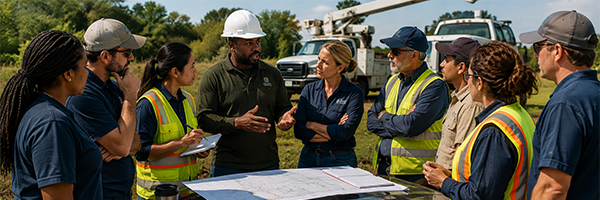
The underground infrastructure was a different story. The only reliable way to understand where many underground lines and assets were located was to talk with the leaders and crews who had spent years working in those areas. Their experience filled gaps that no database contained because, in many cases, the information had never been formally recorded. The organization’s most valuable information system wasn’t technological–it was human.
Knowledge emerges by connecting information. People-Based Information Systems accelerate that process by enabling people to exchange context, experience, and interpretation. They transform isolated observations into shared organizational understanding.
Wisdom develops in much the same way. Facts can be documented, judgment usually cannot. It is transferred through conversations, mentoring, stories, and shared experiences that communicate far more than data alone. For allocentric organizations, this capability is not merely a complement to traditional information systems. It is strategic infrastructure. And even egocentric organizations can experience greater efficiencies by intentionally designing a very simple People-Based Information System.
Organizations that intentionally capture and integrate the observations, experiences, and judgments of their people don’t simply accumulate more information. They perceive reality more completely. And organizations that perceive reality more completely make better decisions.
Before investing in another dashboard, another report, or another analytics platform, stop and ask yourself: What important observations exist only in the minds of our people? The answer may reveal that your organization’s most valuable information system isn’t technological after all.
Executive Insight
Every organization depends on information to make decisions. The challenge is that some of the most valuable information cannot be stored in a traditional database—it must be intentionally captured from people