
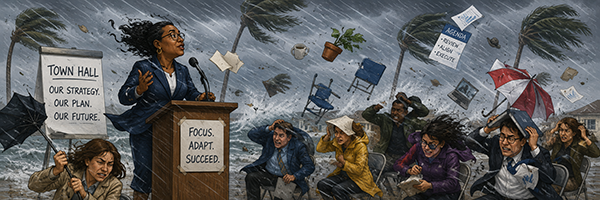
Most leaders are familiar with Organizational Culture. Far fewer spend much time thinking about Organizational Climate. The two are related, but they are not the same. Organizational Climate describes how people affectively experience their organizational environment at a given time. Two factors are particularly important: Organizational Tension and Resistance to Change. Organizational Tension is the amount of stress people experience in their environment. It is reflected in factors such as trust, conflict, morale, perceived fairness of rewards, leadership credibility, and the tendency to blame others when things go wrong. Resistance to Change describes how readily people are willing to respond to changing circumstances. High Resistance to Change tends to be associated with lower-activation emotions such as comfort, boredom, disappointment, or fatigue. Low Resistance to Change tends to be associated with higher-activation emotions ranging from enthusiasm and inspiration to anxiety and fear. Together, Organizational Tension and Resistance to Change tell us a great deal about what it feels like to operate inside an organization.
And that experience can change remarkably quickly. Imagine an organization with a strong Culture and an exceptionally positive Climate. At 8:00 one morning, its leader announces that the company will reduce its workforce by 35 percent. By 8:01, the Culture probably hasn’t changed much. The Climate almost certainly has. That’s one of the important distinctions between Culture and Climate. Culture is comparatively enduring. Climate is much more responsive to current conditions.
So, what constitutes a salubrious Organizational Climate? Last week, I posed a version of that question on LinkedIn. One former client, Sam, made an important observation: a healthy environment can include challenge and “healthy stress.” I agree. Organizational Tension is like personal stress. Too much can become debilitating, but eliminating it altogether isn’t necessarily desirable. Accountability creates tension. Deadlines create tension. Performance expectations create tension. Even vigorous debate can create tension.
This is where the question gets more complicated. Another respondent, Emily, argued that creating a healthy environment and creating one that supports the organization’s strategy are essentially the same thing. She pointed out that debate, differing opinions, and diversity of thought can simultaneously contribute to a healthy environment and improve innovation, creativity, processes, and revenue. Again, I largely agree.
But I don’t think the two are necessarily equivalent. There is no universally ideal Organizational Climate. The most effective Climate is the one aligned with the organization’s strategy and design. What feels positive to organizational members is not necessarily the Climate most propitious for executing the organization’s strategy.
Consider two very different organizations. An allocentric organization is designed to respond readily to its environment. It benefits from relatively low Organizational Tension and low Resistance to Change. Trust, adaptability, and a willingness to respond to changing circumstances reinforce the way the organization is designed to operate. An egocentric organization, by contrast, is designed around efficiency, repeatability, and control. It benefits from higher Organizational Tension and greater Resistance to Change. Greater discipline, scrutiny, process adherence, and resistance to unnecessary variation reinforce that design. Neither Climate is universally superior to the other. Each supports a different organizational requirement.
This is why improving Organizational Climate isn’t necessarily synonymous with reducing tension or making people more comfortable. In some circumstances, leaders may actually need to influence tension upward. In others, reducing tension may be essential. Of course, there are limits. Excessive Organizational Tension can become pathological regardless of strategy, just as too little tension can bring the organization to a standstill.
And leaders don’t control Climate. They influence it by changing the conditions through which people experience the organization: expectations, rewards, structures, information, leadership behaviors, workload, and countless other signals. That changes the leadership question. Instead of asking, “How can we create a better Organizational Climate?” Perhaps we should first ask: “What Organizational Climate does our strategy require, and is that the Climate our people are actually experiencing?” The goal isn’t obtaining some sort of universally better Organizational Climate. The goal is finding the right Organizational Climate.
Executive Insight:
A better Organizational Climate isn’t necessarily a more effective one. Effectiveness depends on how well the Climate supports the organization’s strategy and design.