

Many companies say their people are their greatest asset.
Few design their strategy as if that were actually true.
Every organization must decide where its competitive advantage will come from. Some build their strategy around the products they offer. Others focus on the needs of a particular market and tailor their offerings accordingly. These two approaches—Products Offered and Market Needs—dominate the competitive landscape.
A far smaller group of organizations makes a different—and far more salient—strategic choice.
Rather than organizing themselves around a product or a market, these companies adopt Technology as their Guiding Light. In doing so, they commit to building a proprietary body of knowledge—and the organizational capability required to continually expand and exploit it.
This is a far more demanding strategy to execute. It requires sustained investment, deep expertise, and an organization capable of continual innovation. But when done well, it places a company in an elite competitive position—one where advantage does not depend on a single product or market opportunity, but on the ability to repeatedly generate new ones.
Regardless of the guiding light a company chooses, however, the true engine of innovation is always the same: the ingenuity of its people.
Bright, capable individuals see connections others miss. They identify opportunities hidden within complex problems. They imagine new ways to create value.
When an organization learns how to harness that ingenuity, something remarkable begins to happen. Ideas turn into innovations. Innovations turn into game-changing products and services. And those products and services turn customers into devoted fans.
Over time, this process can create a competitive advantage that is extraordinarily difficult for competitors to replicate.
The question for leaders, therefore, is not simply whether people matter.
The real question is whether the organization has been designed in a way that allows their ingenuity to flourish.
When it is, a clear line of sight begins to emerge between a company’s commitment to culture and the strength of its competitive advantage.
The Line of Sight
When leaders choose to compete through a Guiding Light of Technology, they are making a demanding strategic choice. They are deciding to build the enterprise around a proprietary body of knowledge—and the organizational capability required to continually expand and exploit it.
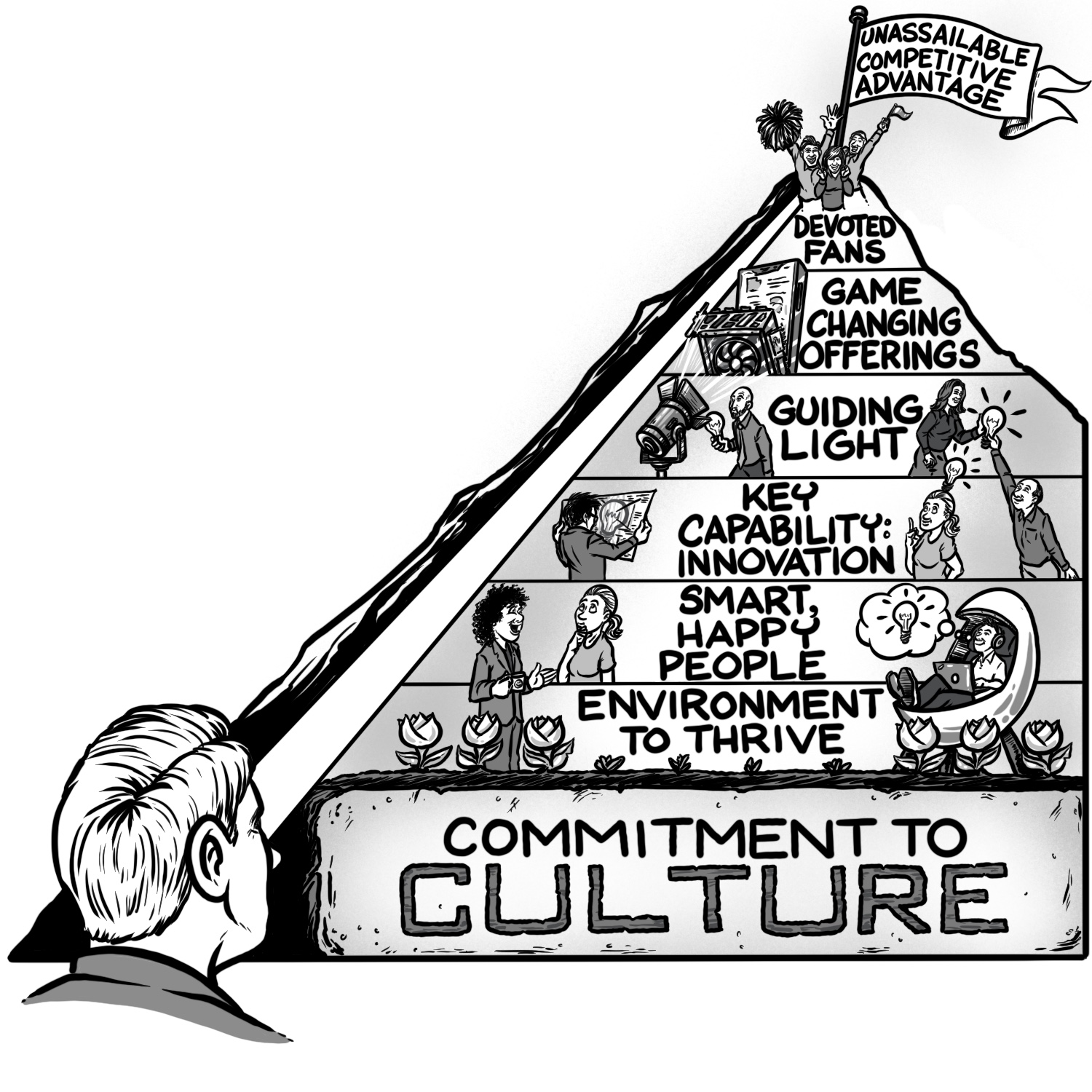
That capability is innovation.
But innovation does not emerge in a vacuum. It begins much further upstream—with culture.
Organizations that succeed with this strategy make a deliberate commitment to culture because they understand that smart and happy people do their best work in environments where they are trusted, supported, and given the freedom to think. Over time, that commitment creates the conditions in which talented individuals can truly thrive.
When enough smart and happy people come together in the right environment, innovation begins to emerge as an endogenous capability of the organization rather than an occasional breakthrough. The company becomes better at generating ideas, uncovering insights, and exploring new possibilities.
Because the organization has adopted a Guiding Light of Technology, it uses that capability of innovation to establish and expand a proprietary body of knowledge—something uniquely its own that competitors cannot easily replicate.
That knowledge becomes the foundation for game-changing products and services. Those products and services create devoted fans. And over time, devoted fans help produce something every company seeks but few achieve: an unassailable competitive advantage.
At the foundation of this system sits culture—the design element around which the rest of the organization must ultimately align.
Seen this way, the line of sight becomes clear.
Culture creates the environment. The environment attracts and sustains smart and happy people. Smart and happy people build innovation as a capability. Innovation builds proprietary knowledge. Proprietary knowledge produces game-changing products and services. And those products and services create the customer devotion that ultimately sustains lasting advantage.
The Kind of People This Strategy Requires
A strategy built around human ingenuity does not succeed with just any workforce. It requires a particular kind of person—and the right conditions for those people to thrive together.
The individuals who contribute most in these environments tend to be intellectually curious. They enjoy solving difficult problems and are energized by the process of discovery. When they encounter complexity, their instinct is not to avoid it, but to explore it.
They notice patterns others overlook. They connect ideas across disciplines. They see possibilities where others see obstacles.
But intelligence alone is not enough.
Organizations that rely on innovation as a core capability need people who are both smart and happy.
Smart people generate insight. Happy people bring the energy, persistence, and emotional commitment required to turn insight into innovation. When those two qualities come together in the same individual, something powerful begins to happen.
Ideas compound. Learning accelerates. Breakthroughs become more frequent.
Organizations pursuing this strategy therefore work deliberately to attract and retain preeminent talent—individuals capable of seeing connections others overlook and translating those insights into meaningful progress.
Put enough smart and happy people together in the right environment, and teams begin to develop a natural rhythm of collaboration. Trust grows. Communication becomes fluid. Individuals challenge one another’s thinking while respecting each other’s expertise.
At that point, the organization is no longer dependent on isolated flashes of brilliance. It has cultivated a workforce capable of consistently transforming human ingenuity into meaningful progress.
Of course, people like this exist in every industry.
The real challenge for leaders is not finding them—it is building an organization where they can thrive.
Which brings us to the next question: what kind of organization makes this possible?
Designing a Culture-Led Organization
If human ingenuity is the engine of innovation, and innovation is the key capability required by a technology-guided strategy, then the design of the organization becomes critically important.
Organizations do not naturally produce the conditions required for ingenuity to flourish. Those conditions must be deliberately designed.
This is where organizational design enters the picture.
Many leaders think of organizational design primarily in terms of structure—boxes on an org chart, reporting relationships, and spans of control. Those elements matter, but they represent only a small part of the system that ultimately shapes how people behave inside an organization.
I once worked on an organizational design project for a high-technology company that claimed innovation was central to its strategy. Naturally, I wanted to understand how innovation was structured inside the organization. When I reviewed their org chart, I discovered that innovation had been bundled together with three completely unrelated functions inside a single department.
Innovation was simply one item in a long list of responsibilities.
That arrangement immediately raised a red flag. If innovation is truly a core capability—especially in an organization guided by technology—then it cannot be treated as an ancillary activity competing for attention with unrelated operational responsibilities. Innovation requires focus. It requires space. And it requires leadership attention.
Culture plays a far more powerful role.
In a culture-led organization, culture becomes the invisible framework that guides behavior across the enterprise. Shared values, norms, and expectations influence how people interact, how decisions are made, and how conflicts are resolved. Over time, this cultural framework becomes a far more reliable source of guidance than formal authority alone.
What makes a culture-led organization different is that culture becomes the design anchor for the enterprise. Once culture is defined, it does not move. Instead, every other element of the organization—strategy, structure, processes, incentives, and roles—must adjust to align with and reinforce it.
When culture is designed intentionally, it reinforces the conditions required for smart and happy people to do their best work. Trust grows. Communication becomes more open. Individuals feel safe challenging ideas and exploring new possibilities.
These reinforcing conditions are essential for sustaining innovation as a capability.
Without them, even the most talented people eventually find themselves constrained by bureaucracy, discouraged by internal friction, or exhausted by organizational politics.
In fact, many organizations unintentionally suppress the very ingenuity they depend on. Layers of approval, rigid hierarchies, and narrowly defined roles can quietly squeeze the life out of creative thinking.
With the right organizational design, however, the opposite begins to happen. Ideas move faster. Teams learn from one another. Problems are solved closer to where they emerge.
In effect, good organizational design removes the friction that would otherwise suppress human ingenuity. When that friction disappears, innovation begins to flow naturally through the organization.
How This Strategy Compares to Traditional Approaches
Most organizations do not build their strategy around human ingenuity.
Instead, they tend to organize themselves around one of two guiding lights: the products they offer or the markets they serve.
In a product-led strategy, the company focuses on building superior products and then finding customers who want them. In a market-led strategy, the organization concentrates on understanding a particular customer segment and designing products or services to meet its needs.
Both approaches are common for a reason. They are relatively straightforward to understand and comparatively easy to execute. Leaders can see the product. They can measure the market. The strategic logic feels tangible.
But both approaches share a limitation.
Over time, competitors inevitably catch up. Products improve across the industry. Market insights spread. What was once a differentiator gradually becomes table stakes.
A strategy guided by Technology operates differently.
Instead of organizing itself around a specific product or market, the organization focuses on building a proprietary body of knowledge and the capability required to continually expand it. That knowledge becomes the foundation from which new products and services can emerge again and again.
In this model, competitive advantage does not depend on a single breakthrough. It depends on the organization’s ability to repeatedly generate them.
And that ability ultimately traces back to the same source we began with: the ingenuity of its people.
This is why the people choice matters.
When leaders commit to building an environment where smart and happy people can thrive—and when the organization is deliberately designed to remove the friction that suppresses their ingenuity—innovation becomes more than an occasional event. It becomes part of how the organization works.
Over time, that capability compounds. Knowledge expands. Game-changing products and services emerge. Customers become devoted fans.
In the end, the organizations that win are often the ones that made the people choice first.

0 Comments