

The Difference Between Complicated and Complex
When strategy stalls, leaders often search for someone who can diagnose the problem and fix it—like calling an auto mechanic for a broken engine.
It’s an understandable instinct. Many of the problems we encounter in business really do behave this way. When something stops working, we investigate the cause, repair the faulty component, and restore the system to proper operation.
In other words, we treat the organization like a machine.
The challenge is that many of the most important strategy problems don’t behave like machines at all.
They behave like complex systems.
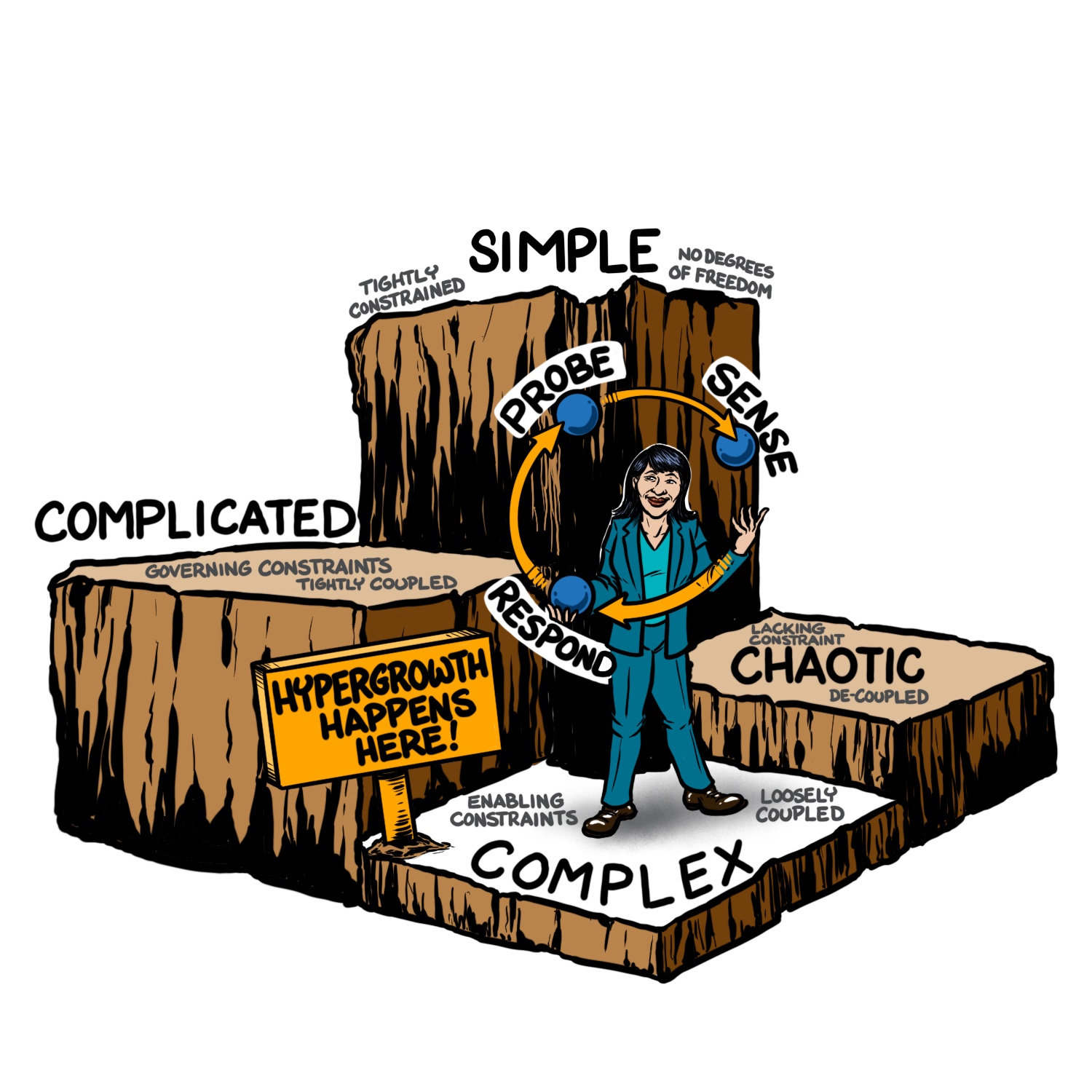
One of the most useful frameworks for understanding this distinction comes from Dave Snowden’s Cynefin framework, which distinguishes between several different types of problem environments. Two of the most commonly confused are the complicated and complex domains.
In a complicated environment, cause-and-effect relationships exist, even if they are difficult to identify. With enough expertise, analysis, and investigation, the right answer can usually be discovered.
This is the world of engineers, surgeons, and yes—auto mechanics. Problems may be intricate, but they are ultimately solvable through careful diagnosis and expert intervention.
A complex environment behaves very differently.
In complex systems, cause and effect cannot be fully understood in advance. Patterns only become clear after events unfold. Actions interact with other forces in the system, often producing outcomes that are difficult to predict.
Most competitive environments behave this way.
Markets evolve. Competitors respond. Technologies shift. Customer preferences change. Small developments in one part of the system can ripple outward in unexpected ways.
Because strategy is fundamentally an organization’s mechanism for navigating that external environment, strategy itself must contend with complexity.
And while complex environments can feel uncomfortable, they are often where the most significant opportunities for innovation and growth emerge.
In a complex environment, there is no single faulty component to diagnose and repair.
Instead, leaders must continuously interpret signals, adapt their actions, and guide the organization as new information emerges.
Where Strategy Realization Often Breaks Down
If most competitive environments are complex, why do so many strategy realization efforts struggle?
In many cases, the problem is not the strategy itself.
The problem is the mental model leaders bring to the work of realizing it.
Many organizations attempt to implement strategy as if they were operating in a complicated environment rather than a complex one. They assume that if the right plan is developed, the right structure installed, and the right initiatives launched, the organization will move predictably toward its intended outcome.
This mindset treats strategy realization as a form of organizational engineering.
Diagnose the problem.
Apply the solution.
Expect the system to respond as designed.
It’s the same mindset an auto mechanic brings to a malfunctioning engine.
If the engine isn’t running properly, something inside the machine must be broken. Once the faulty component is identified and repaired, the system should return to normal operation.
This logic works extremely well in complicated systems.
It works far less well in complex ones.
Organizations are not static machines. They are dynamic social systems composed of individuals who interpret information, respond to incentives, and influence one another in ways that are often difficult to predict.
As strategy begins to interact with this environment, unexpected reactions emerge.
Some initiatives gain momentum.
Others stall.
Small interventions sometimes produce nonlinear effects, where relatively modest actions trigger disproportionately large responses.
New patterns—often emergent ones—begin to appear across the system.
In these moments, leaders operating with a complicated mindset often attempt to “fix” the strategy.
But the strategy is rarely the problem.
More often, the issue is that leaders are attempting to manage a complex system as though it were a complicated one.
The Management System Required for Complex Environments
If strategy realization unfolds within a complex environment, leaders need a management system that can operate effectively within that reality.
Instead of assuming that the correct path can be fully determined in advance, leaders must continually probe the environment, sense emerging signals, and adapt accordingly.
In my own work, this capability resides within what I call the organization’s Strategic Guidance System.
The Strategic Guidance System includes mechanisms that help leaders interpret what is happening both inside and outside the organization. Increasingly, systems such as the Prophet Center play an important role in this process by helping the organization detect patterns, synthesize information, and surface signals that might otherwise remain hidden.
Together, these capabilities allow the enterprise to continuously probe and sense the environment.
But sensing alone is not enough.
Ultimately, leaders must decide how the organization should respond.
Sometimes the signals call for relatively small adjustments—what we might think of as transactional changes that refine existing activities.
At other times, the organization may need to adjust direction more meaningfully. These transitional changes often involve modifying priorities, shifting resources, or updating elements of the organization’s strategic direction.
And occasionally, the signals emerging from the environment point to something more profound.
In those moments, leaders may recognize the need for transformational change.
Why Transformational Change Is Different
Not all change initiatives are created equal.
In my experience, organizational change generally falls into three categories: transactional, transitional, and transformational change.
Transactional change occurs when both the destination and the path to reach it are known. The organization understands what outcome it is trying to achieve, and it also knows how to get there.
In these situations, the task is largely one of execution.
Transitional change is more demanding.
In transitional change, the destination is clear, but the path to reach it is not. Leaders know where they want the organization to go, but determining the best path forward often requires deeper analysis, specialized expertise, or the careful coordination of multiple initiatives.
The organization must work its way toward the destination, but the journey can usually be clarified through investigation and expert insight.
Transformational change is something else entirely.
Here the organization is no longer operating within an ordered system where careful analysis can eventually reveal the correct path forward. Instead, leaders find themselves confronting a situation where the destination itself cannot be known in advance.
Because the system is complex, outcomes emerge through interaction between many different forces—market dynamics, technological shifts, competitive responses, and human behavior inside the organization itself.
Even the most capable experts cannot fully determine where the organization will ultimately land.
The destination is not discovered through analysis.
It is emergent.
I was reminded of this dynamic while working with the strategic business unit leader of a major oil and gas company. During a series of focus groups, we were discussing the scale of change the organization was about to undertake. Many participants initially assumed the effort would follow a familiar pattern—identify the target state, develop the plan, and execute the transition.
But as the conversation unfolded, it became clear that what the organization was facing was something different. The destination itself had not yet taken shape. The leadership team knew the current model could not continue, but the future state would only become clear as the organization began interacting with the changing environment around it.
For many in the room, this realization was both unsettling and liberating.
Once people understood that they were dealing with transformational change, the expectation that someone could simply “figure out the answer” began to fade.
The task was no longer to engineer the destination in advance.
The task was to guide the organization as the future emerged.
When the Vision Keeps Changing
If transformational change unfolds within a complex system, leaders face a challenge that can feel deeply uncomfortable.
The destination itself is still emerging.
Organizations naturally want clarity. People want to know where they are going and how they will get there. They look to leadership for a stable picture of the future.
But in complex environments, that picture cannot always be drawn in advance.
As signals from the environment evolve, leaders often find themselves adjusting their understanding of the future.
In these moments, leaders sometimes worry that changing the vision will undermine confidence inside the organization.
In reality, the opposite is often true.
What organizations need in complex environments is not a perfectly static vision. They need leaders who can continuously interpret the emerging future and help the organization move toward it.
This is where storytelling becomes one of the most important tools in strategy realization.
In earlier work, I described a process called Visionography—the discipline of helping an organization see the future it is moving toward.
In complex environments, Visionography becomes something more dynamic.
Instead of describing a single predetermined outcome, leaders are helping the organization interpret an unfolding narrative.
As new signals appear and patterns begin to emerge, the story of the future evolves.
The leader’s role is not to pretend that the destination was known all along.
The leader’s role is to help the organization make sense of the journey.
Because in complex environments, the future is rarely engineered.
It is discovered.

0 Comments