

The Opportunity
Artificial intelligence has quickly become one of the most talked-about technologies in modern business. Leaders everywhere are experimenting with new tools designed to automate tasks, analyze data, and accelerate decision-making.
Most of these efforts focus on productivity.
While those improvements are useful, they miss the far more important opportunity.
Artificial intelligence does not simply make organizations more efficient. Used thoughtfully, it can make them dramatically more capable.
The real transformation occurs when artificial intelligence becomes integrated into the cognitive fabric of the enterprise—when human judgment and machine intelligence begin operating together as a single system. At that point, the organization gains something it never had before: augmented cognition at scale.
At that point, the organization becomes something new: a Cybernetic Organization, or what I simply call a CybOrg.
In a CybOrg, artificial intelligence does not replace people. Instead, it amplifies their ability to think, analyze, and explore possibilities.
Humans can still compete with humans.
But it is very difficult for humans to compete with people whose capabilities have been amplified by machines.
Organizations that learn how to create these amplified decision-makers may soon find themselves operating at a level of capability their competitors struggle to match.
Where the Cyborg Idea Came From
The idea of the cyborg did not originate in science fiction.
In 1960, researchers Manfred Clynes and Nathan Kline introduced the concept while studying how humans might survive in extreme environments such as outer space. Their insight was elegantly simple: rather than redesigning the environment to suit humans, we could augment humans with technology so they could thrive within it.
In popular culture, the idea eventually evolved into images of half-human, half-machine characters. But the original concept was far more subtle.
The goal was not to replace the human. It was to extend human capability seamlessly.
When the technology worked properly, the person would not even think about it. It would simply become part of how they functioned.
Artificial intelligence creates a similar opportunity for modern organizations.
Instead of augmenting physical capability, AI augments something far more important in the modern economy: human cognition.
When integrated effectively, artificial intelligence becomes a partner in reasoning—helping people explore ideas, detect patterns, challenge assumptions, and synthesize information at a scale that would otherwise be impossible.
This is where the concept of the CybOrg begins to emerge.
But building a cybernetic organization requires more than simply deploying AI tools. It requires designing the system that allows human and machine intelligence to operate together.
Systems designed for this purpose are what I call Prophet Centers.
The Prophet Center
If artificial intelligence is going to elevate human capability, organizations need more than a collection of AI tools scattered across the enterprise. They need a system that integrates human intelligence and machine intelligence into a coherent whole.
That system is the Prophet Center.
The Prophet Center functions as the cognitive core of the cybernetic organization. It connects the enterprise’s proprietary knowledge with the broader intelligence of the outside world and makes that combined capability available to every citizen of the organization.
Traditional systems are excellent at processing codified information—the structured data found in databases, reports, dashboards, and documents. For decades, organizations have relied on these systems to track operations, analyze performance, and support decision-making.
But the most valuable knowledge inside organizations often exists in a different form.
It is tacit.
Tacit knowledge lives in conversations, experience, intuition, and context. It flows between people through dialogue rather than through spreadsheets or reports. Because of this, organizations have historically struggled to capture it, amplify it, or reuse it effectively.
Modern AI systems change that equation.
When employees interact with the Prophet Center conversationally, they are engaging in what might be called an epistemic exchange—a dialogue through which knowledge is refined and new insight emerges.
Over time, these interactions begin to create something remarkable: a shared cognitive fabric across the enterprise—a layer of collective intelligence that connects the thinking of the organization’s citizens.
I recently saw an early version of this idea while working with a leading biopharmaceutical company that is building an AI system designed to serve as a corporate “coach” for its employees. Instead of simply retrieving information, the system interacts with people conversationally—helping them think through problems, ask better questions, and explore possible solutions.
What struck me most was not the technology itself, but the shift in how people were using it. Employees were not treating the system as a search engine or a reporting tool. They were treating it as a thinking partner.
That subtle shift—when people begin interacting with AI as a collaborator in their reasoning—is often the first sign that an organization is beginning to develop the kind of cognitive infrastructure that makes a cybernetic organization possible.
Steering Around Today’s AI Landmines
As exciting as artificial intelligence has become, many organizations are approaching it in ways that are unlikely to produce meaningful advantage.
In the current wave of enthusiasm, leaders understandably feel pressure to demonstrate that their companies are “doing something with AI.” Boards ask about it. Investors expect it. Employees read about it in the news.
The result is a growing number of AI experiments driven more by momentum than by strategy.
Teams deploy chatbots. Analysts experiment with generative tools. Pilot projects appear across different departments. These initiatives can be interesting—and sometimes even useful—but they rarely add up to anything transformative.
The problem is not the technology.
The problem is the absence of clear strategic intent.
Without that clarity, most initiatives remain fragmented experiments rather than part of a deliberate capability.
Artificial intelligence is a remarkably versatile capability. It can improve productivity, accelerate analysis, automate routine tasks, and enhance customer interactions.
But leaders hoping to create a more profound competitive advantage should ask a deeper question:
What role should artificial intelligence play in the design of our organization?
Without that level of clarity, AI initiatives tend to remain fragmented. Knowledge stays scattered across systems. Insights generated in one part of the enterprise rarely influence thinking elsewhere.
The organizations that ultimately gain the greatest advantage from artificial intelligence will not simply deploy more tools than their competitors.
They will deploy them with purpose, creating forms of competitive asymmetry that are difficult for traditional competitors to match.
How to Become a CybOrg Leader
At the highest levels of an organization, leadership effectiveness is largely defined by performance in five areas:
- Strategic decision making
- Strategy development
- Innovation
- Organizational design
- Employee inspiration and motivation
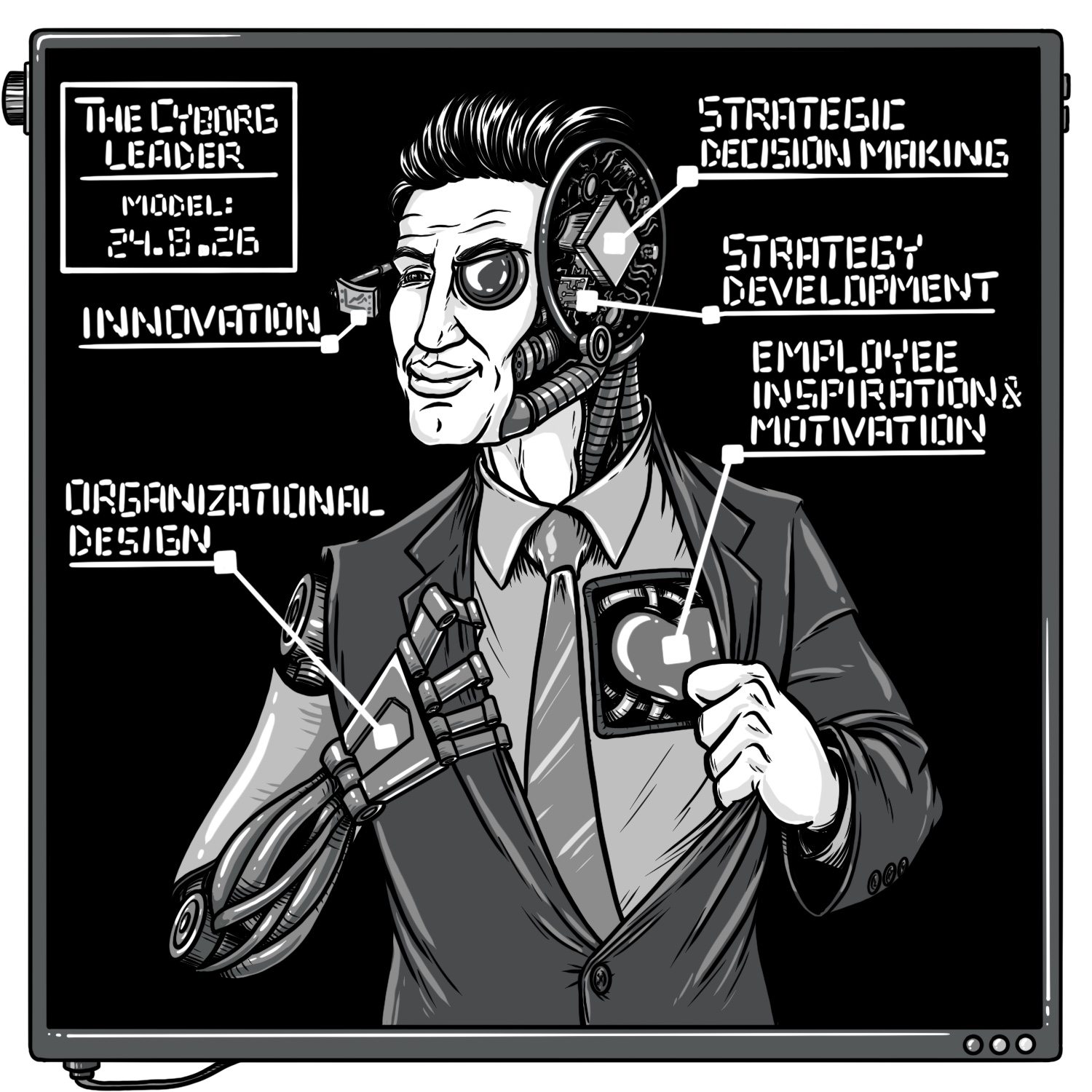
These responsibilities are the primary levers of leadership effectiveness.
What modern technology can do, however, is dramatically amplify a leader’s ability to perform them well.
By interacting continuously with the Prophet Center, leaders gain access to an evolving intelligence layer that helps them explore ideas, challenge assumptions, and evaluate alternatives more quickly and more thoroughly than ever before.
When making strategic decisions, the system can surface patterns, analyze scenarios, and test potential outcomes.
When developing strategy, it can help leaders probe the external environment and identify emerging signals that may warrant attention.
When shaping organizational design, it can illuminate how structural changes may influence performance across the enterprise.
When fueling innovation, it can help surface ideas and connections that might otherwise remain hidden.
And when inspiring people, it can help leaders better understand what motivates and demotivates their teams.
When used this way, the Prophet Center helps leaders cultivate a salubrious environment—one marked by curiosity, trust, and intellectual energy—where experimentation and insight can flourish.
Over time, leaders who learn to operate this way begin to exhibit something remarkable.
Their thinking accelerates.
Their insight deepens.
Their ability to lead grows stronger.
And when leaders begin operating at that level, they set the tone for the rest of the organization to do the same.
What Happens When AI Replaces Your Best People?
One of the most common fears surrounding artificial intelligence is that it will replace people.
In some cases, that concern is justified. Certain tasks that once required human effort will increasingly be performed by machines. This has been true of nearly every major technological advancement throughout history.
But the more interesting question is not what happens when AI replaces average work.
The real question is:
What happens when AI can perform some of the work once done by your best people?
At first glance, this may sound alarming. High performers are often the individuals organizations depend on most heavily.
But when artificial intelligence assumes certain cognitive tasks—rapid analysis, pattern recognition, large-scale synthesis—it frees talented people from the mental bandwidth those activities once consumed.
Instead of assembling information, they interpret it.
Instead of searching for patterns, they explore the implications.
Instead of grinding through analysis, they imagine new possibilities.
In other words, the role of the human expert shifts upward.
What once required their full attention becomes part of the cognitive infrastructure of the organization.
This is how ultra-humans begin to emerge.
Multiply that capability across an entire organization and something remarkable happens.
The enterprise starts to learn faster.
It detects patterns sooner.
It responds to change more intelligently.
Not because machines have replaced people.
But because people have learned how to think with machines.
In that moment, the organization crosses an important threshold.
It stops behaving like a traditional enterprise and begins functioning as a cybernetic organization.
Humans can still compete with humans.
But it is very difficult for humans to compete with ultra-humans.