

Why We Need Yet Another Model for Organizational Design
The world does not need another organizational design model. At least, that is what I might have said years ago. The field is already crowded with useful frameworks—from Galbraith’s Star Model to McKinsey’s 7S and the Nadler–Tushman Congruence Model. Yet the question keeps resurfacing because the organizational design challenge itself has changed in fundamental ways.
Leaders today are trying to build coherent organizations in environments defined by complexity, accelerated change, and relentless information pressure. In many respects, we are operating in an interregnum—a period between the assumptions that shaped earlier management models and the realities organizations now confront.
This does not mean earlier models failed to recognize the systemic nature of organizations. Quite the opposite. Many were explicitly designed to balance interacting elements of the enterprise. Galbraith’s Star Model, for example, highlights the importance of coordinating strategy, structure, processes, rewards, and people within a coherent system. The challenge today is not that organizational design ignores interdependence, but that the conditions under which organizations must achieve that balance have become far more demanding.
Three developments in particular have reshaped the design landscape.
First, many organizations now compete in environments that behave less like predictable machines and more like complex systems. Cause-and-effect relationships are often ambiguous and only fully understood in retrospect, making the competitive environment far more recondite than the relatively predictable systems earlier management models were designed to address.
Second, the pace of change has accelerated dramatically. Advances in technology and the explosive availability of information have compressed decision cycles and increased the speed at which markets evolve. Organizations must now operate in environments defined by the three classic characteristics of modern information systems: velocity, volume, and variety.
A third development is more subtle but equally important. While organizational design has long focused on achieving alignment among structural elements, relatively few models explicitly address whether the organization can operate in a state of flow.
In psychology, flow describes the condition in which individuals perform at their highest level—fully engaged, focused, and able to move through challenges with minimal friction. A similar phenomenon can emerge at the organizational level as well. When the elements of an enterprise not only align but reinforce one another, the organization begins to move with a comparable sense of fluidity. Decisions reach the right places quickly, information travels efficiently through the system, and teams can focus their energy on creating value rather than navigating internal obstacles.
I first encountered something like this early in my career.
At the time, I was working at Silicon Graphics, one of the most innovative technology companies of its era. The work was demanding and the pace was intense. Yet something about the environment made the experience fundamentally different from the burnout many people associate with high-pressure organizations.
Despite the long hours, I rarely felt exhausted by the work itself. Instead, I often found myself deeply absorbed in it. Problems were challenging but solvable. Information moved quickly between teams. Decisions could be made without excessive friction. The organization seemed to operate with a natural cadence that allowed people to focus their energy on solving problems rather than navigating bureaucracy.
Looking back, I now recognize that many of the elements of the organization were reinforcing one another in ways that made that cadence possible. Teams understood how their work contributed to value creation, information moved efficiently across the enterprise, and authority generally existed where decisions needed to be made.
What I was experiencing was something very close to flow, not just at the individual level but across the organization itself.
That experience has stayed with me throughout my career. When I work with leadership teams today, I often find myself asking a simple question: what would it take for this organization to operate in that same state of flow?
The answer rarely lies in a single structural change. More often, it requires aligning the elements of the enterprise so they reinforce one another and allow the organization to move with coherence and momentum.
That is the purpose of DHARMA.
What DHARMA Provides
DHARMA—the Design Harmony, Alignment, and Reinforcement Modeling Approach—is a systems framework for organizational design built around a simple premise: the effectiveness of an organization depends less on the strength of any single element than on how well the elements of the system work together.
One way to visualize this relationship is as a wheel.
The model is represented by the Dharma Wheel, or Dharmachakra, where each spoke represents a critical element of organizational design.
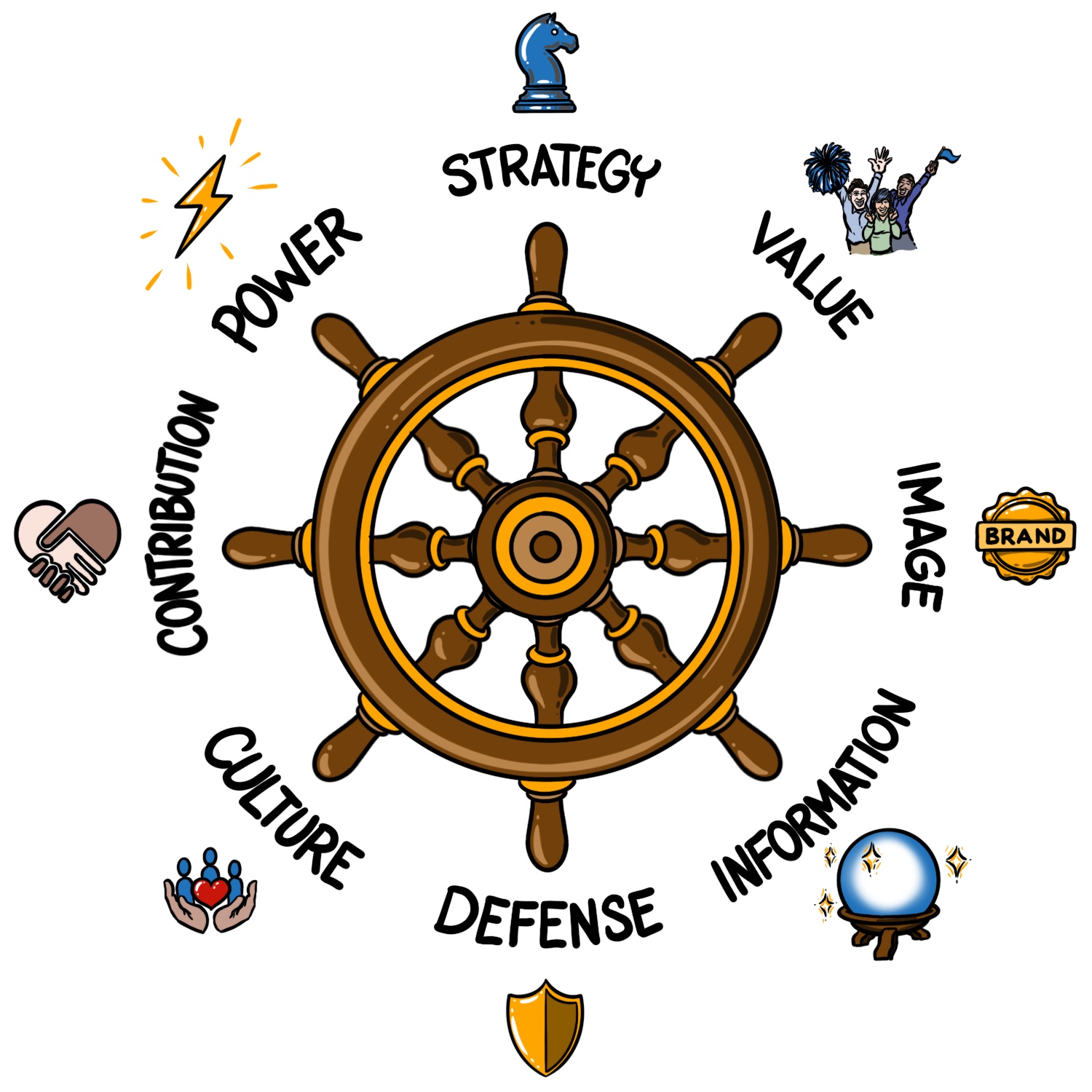
When the elements of the organization are properly aligned, each spoke connects coherently between the center of the enterprise and the outer boundary of the system. When those elements reinforce one another, the structure of the wheel becomes stronger and more stable.
As with any wheel, the integrity of the whole depends on the strength and balance of its spokes; when one weakens or drifts out of alignment, the entire system begins to wobble.
When alignment and reinforcement are both present, the organization begins to operate in harmony—much like a well-balanced wheel turning smoothly under load.
DHARMA identifies eight elements that shape the architecture of the enterprise: Strategy, Value, Image, Information, Defense, Culture, Contribution, and Power. These elements are deeply interconnected. Pressure applied to any one of them inevitably affects the others, just as the spokes of a wheel respond collectively when the system encounters resistance.
Re-framing the Classic Elements
Most organizational design frameworks focus on a familiar set of variables: strategy, structure, processes, incentives, decision rights, and culture. DHARMA does not abandon these ideas. Many of the concepts long discussed in organizational design appear within the model.
What changes is the scope and framing of those elements.
In several cases, ideas traditionally treated as narrow design variables are elevated into broader systemic domains.
Take Structure, for example. In many organizational design discussions, structure primarily refers to reporting relationships and formal authority. Within DHARMA, these structural arrangements sit within the broader element of Power. Formal hierarchy remains important, but it represents only one mechanism through which influence operates within an organization. Drawing on the classic work of French and Raven, Power also encompasses other forms of influence—such as expertise, incentives, and social authority—that organizations use to mobilize effort and coordinate activity.
A similar shift occurs with process design. Traditional models frequently focus on processes as the mechanisms through which work moves through the enterprise. DHARMA expands this idea into the broader element of Value. Processes remain important, but they exist within a larger architecture that defines how value is created and delivered to customers. Value chains, operating models, and the fundamental flow of work through the organization all fall within this domain.
The emphasis therefore shifts from individual processes to the overall system of value delivery—the mechanisms through which the organization ultimately fulfills its raison d’être, the fundamental purpose for which the enterprise exists.
Other elements familiar to organizational designers also appear within the framework. Information captures the movement of both codified and tacit knowledge through the enterprise. Culture reflects the norms and expectations that shape behavior within the system. Strategy continues to provide the directional context that guides the organization as a whole.
In this way, DHARMA preserves much of the intellectual foundation of traditional organizational design while expanding several of its core concepts.
Delving into the New Elements
While several elements within DHARMA reflect ideas long discussed in organizational design, others bring attention to dimensions that traditional frameworks have often treated only indirectly.
One such dimension is Image. Organizations do not operate in isolation; they exist within broader ecosystems of customers, partners, regulators, and communities. The way an organization is perceived by these external audiences can profoundly influence its ability to attract talent, build trust, and sustain legitimacy. Yet reputation and external perception are rarely treated as core elements of organizational design.
Another element is Defense. Every organization must remain viable within the competitive environment in which it operates. Markets evolve, technologies change, and strategic assumptions that once appeared sound can gradually become obsolete. Within DHARMA, Defense represents the capabilities that safeguard the long-term survival of the enterprise—the organization’s ability to recognize emerging threats, adapt to changing conditions, and maintain technical and strategic solvency.
Finally, DHARMA introduces the element of Contribution, which reflects the organization’s role within the broader systems in which it operates. Increasingly, stakeholders expect organizations to consider not only the value they generate for customers and shareholders, but also the impact they have on society. Contribution captures this dimension by connecting the organization’s activities to broader societal outcomes, including the United Nations Sustainable Development Goals.
The Insidious Problem with Org Charts
For most leaders, the starting point for thinking about organizational design is the org chart. The familiar diagram of boxes and reporting relationships appears to explain how the organization works.
But this apparent clarity can be deceptive.
Org charts illustrate authority relationships—who reports to whom and where formal responsibility resides. While useful administratively, they can distort how leaders think about organizations.
As Peter Drucker once observed, “The organization is not a structure of power, but a structure of responsibility.”
Org charts capture the formal hierarchy, but they reveal very little about how value actually moves through the enterprise, how information travels across teams, or how influence mobilizes people to act.
The chart suggests that the organization is primarily a hierarchy of positions. In reality, organizations function much more like systems of flows.
Value moves through the enterprise as work progresses from one activity to the next. Information travels between teams as people interpret signals from the environment and coordinate decisions. Influence and authority shape how people are mobilized within those flows. Culture shapes how individuals behave within the system.
None of these dynamics are visible on an org chart.
DHARMA offers a different way of visualizing the enterprise. Instead of seeing the organization primarily as a hierarchy, the model presents it as a system of interacting elements—a wheel whose strength and motion depend on how well its spokes align and reinforce one another.
Designing for Optimization Instead of Transformation
Organizational design efforts are often framed as large-scale transformation initiatives. Leaders launch restructuring programs or introduce sweeping new operating models in response to changing conditions. These efforts can produce meaningful improvements, but they are disruptive, costly, and difficult to sustain.
In many cases, the need for transformation arises not because radical change was required from the outset, but because smaller design issues were allowed to accumulate over time.
DHARMA does not prescribe a management workflow. Instead, it provides a way to see the architecture of the organization more clearly. By making the key elements of the enterprise visible—and by highlighting how they align with and reinforce one another—the model makes it easier for leaders to identify design issues before they become systemic problems.
One of the clearest signals appears in the presence—or absence—of organizational flow.
When an organization is operating in a state of flow, value moves efficiently through the enterprise, information reaches the right people at the right time, and teams can focus their energy on creating value rather than navigating internal friction. In such circumstances, the most effective course of action is often to sustain the current design rather than disrupt it unnecessarily.
Disruptions to organizational flow, however, often signal deeper structural issues. Sometimes the problem lies in reinforcement, where elements that remain broadly aligned no longer strengthen one another effectively. If such issues persist long enough, leaders eventually encounter alignment problems, where the fundamental elements of the enterprise are no longer positioned coherently within the architecture of the system.
When misalignment reaches this stage, leaders often feel compelled to pursue large-scale transformation.
Yet many of these transformations could have been avoided.
By observing organizational flow and addressing reinforcement and alignment issues as they emerge, leaders can maintain a healthy organizational architecture over time. In this sense, the goal of organizational design is not to repeatedly reinvent the enterprise, but to practice continual stewardship of the system so that the wheel keeps turning smoothly.
When the elements of the organization are aligned and reinforce one another, the wheel turns smoothly—and the enterprise can move forward with coherence, strength, and purpose.