

Strategy may be the most overused word in the language of business.
Companies create strategic plans, hold strategic offsites, and launch strategic initiatives. The result is often a farrago of activity loosely labeled “strategy,” but rarely anchored in a coherent understanding of what strategy actually is.
More often than not, what organizations call strategy is simply planning wearing a more sophisticated name.
But strategy is not a plan.
An organization’s strategy is the framework that guides decisions about what the organization is and where it is going. Strategy clarifies intent. It provides the lens through which leaders evaluate opportunities, make trade-offs, and steer the enterprise over time. Without such guidance, organizations often end up with a very good plan for going to the wrong place.
This confusion is partly a reflection of the management zeitgeist. Strategy is frequently discussed in terms of growth initiatives, transformation programs, or long-range planning. Yet none of those things actually define strategy. Planning answers the question of how to get somewhere. Strategy answers the far more fundamental question of what the organization should become.
Once that question is clear, planning becomes far easier. When it is not, planning becomes little more than organized guessing.
Strategy as a Framework for Guidance
To provide meaningful guidance, strategy must function as a coherent framework.
This figure illustrates the strategic framework that I often use when working with leadership teams:
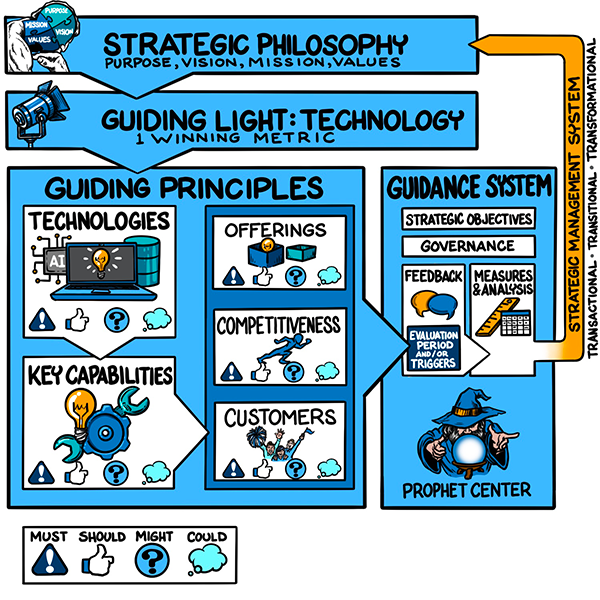
At the top sits the organization’s Strategic Philosophy, which clarifies its vision, mission, purpose, and values. These elements express where the organization intends to go, what it exists to do, why it exists at all, and what it cares about along the way.
From this philosophy emerges the organization’s Guiding Light—the cornerstone logic around which the enterprise organizes its strategy. Some organizations organize themselves around the products they choose to offer. Others center their strategy on the needs of a particular market. In certain cases, particularly among what I call precocious organizations—firms built around exceptional talent and ideas—, the guiding light may be a proprietary body of knowledge or technology that the firm seeks to exploit.
I saw this dynamic play out clearly while helping the leadership team of a precocious high-tech firm develop a hyper-growth strategy. The company had already built a remarkable business, but the leaders were wrestling with how to scale from roughly $1 billion to $5 billion in revenue within four years. After examining their capabilities and opportunity landscape, it became clear that Technology—their proprietary body of knowledge and the organizational capability required to exploit it—was the only Guiding Light capable of supporting that ambition.
Once that choice was clarified, many downstream decisions about markets, offerings, and capabilities became dramatically easier.
The guiding light then shapes a set of Guiding Principles that influence decisions across areas such as customers, offerings, competitiveness, organizational capabilities, and technologies. These principles provide the operating guidance that allows leaders throughout the enterprise to make decisions that remain consistent with the organization’s intended direction.
When this framework is clear, decision-making accelerates dramatically. Leaders and teams no longer need to debate every opportunity from first principles; they can simply ask whether the opportunity aligns with the strategic guidance already in place.
The Strategic Fork
Within this system of guidance lies one of the most consequential decisions leaders ever make.
Roger Martin’s well-known strategy framework, articulated in Playing to Win, describes strategy as a cascade of choices, including where to play and how to win. In practice, the most critical moment in that cascade occurs when leaders confront the question of how their organization intends to win.
At its core, this choice usually resolves into a remarkably simple fork in the road: will the organization compete through cost, or through value?
Organizations that pursue cost advantage seek to win through efficiency. They optimize processes, scale operations, standardize offerings, and relentlessly reduce costs. Their competitive strength comes from delivering acceptable value to customers at a lower cost structure than competitors can sustain.
Organizations pursuing value take a different path. Rather than competing primarily on efficiency, they focus on delivering outcomes customers perceive as meaningfully better. These firms often compete through innovation, talent, unique capabilities, or deeper insight into customer needs.
Both approaches can succeed. What matters is that leaders choose deliberately.
The Implications of Value
Organizations pursuing customer value often develop what I call an allocentric orientation—a posture in which the firm continually scans its environment and innovates around customer needs and opportunities.
Allocentric organizations are outward-facing by design. They constantly interpret signals from customers, markets, and emerging technologies, adapting their offerings as new information emerges. This orientation often produces powerful advantages in environments where customer expectations evolve quickly and innovation becomes the primary engine of growth.
The Ambidexterity Challenge
Of course, some leaders attempt to pursue both cost and value simultaneously. These firms are often described as ambidextrous organizations.
In theory, this approach is possible. With the right leadership discipline, governance structures, and organizational design, a company can attempt to balance efficiency and innovation within the same enterprise.
In practice, however, discussions of ambidextrous organizations are often facile, underestimating the extraordinary leadership discipline and organizational design required to make such systems function effectively.
Even when organizations manage to build a functionally ambidextrous structure internally, they still face an unforgiving reality in the marketplace.
Customers rarely reward organizations for being competent in two dimensions. Markets tend to favor clarity. As Roger Martin observes, firms ultimately succeed by becoming the cost leader or the value leader, not merely a participant in either category.
The Leadership Imperative
This is why the most important strategy decision leaders make is deciding whether to be the undisputed cost leader or the undisputed differentiator.
Cost leadership and value leadership are both legitimate paths. Ambidextrous organizations may even succeed under exceptional circumstances. But what organizations cannot afford is strategic ambiguity.
Strategy exists to guide decisions. The most important guidance leaders can provide is clarity about how the organization intends to win.
Once that decision is made, everything else—from organizational design to talent strategy to innovation—begins to fall into place.