
By now, most leaders have moved beyond annual planning and are back in the gravitational pull of day-to-day execution.
Recently, I began working with a senior leader at a major pharmaceutical company who is struggling to focus on strategy because she is deeply immersed in tactical and operational work. This is a familiar pattern. Leaders who are exceptional individual contributors often feel the urgency of immediate problems more acutely than the quieter, longer-term work of strategy.
The irony is that strategic progress rarely comes from doing more yourself. It comes from providing clearer guidance so your team can execute at the level you envision.
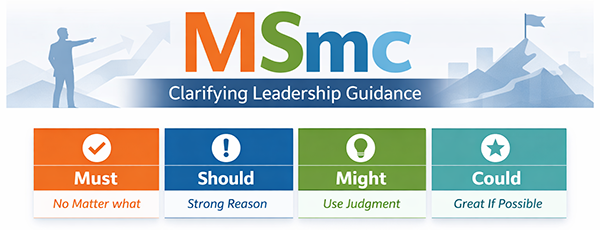
One simple tool I introduce in Grow Your Business UP! (p. 57) is MSmc — a framework that clarifies expectations when assigning work or defining objectives.
Here’s how it works. Align with your team on the meaning of four words:
- Must — This condition must be met, no matter what.
- Should — There should be a strong reason if this condition is not met.
- Might — Use your judgment; meet this condition if it makes sense.
- Could — This would be great to achieve, but it’s optional.
I originally developed MSmc as a priority-setting tool, but after years of coaching leaders on delegation, I’ve found it to be equally powerful for structuring guidance. It gives teams clarity, reduces unnecessary escalation, and allows leaders to lift out of execution and back into strategy.
As you look at your own workload this month, ask yourself: Am I providing clear enough guidance to my team so I can focus on strategy?
I’d be curious to hear about your successes and challenges in this area.